 blog
blog
Business Alarm System Monitoring Plans: A 2026 Guide
Table of Contents
- What Business Alarm System Monitoring Plans Cover
- Professional Monitoring vs. Self-Monitoring for Commercial Properties
- Commercial Security System Pricing and Cost Factors
- Business Alarm Monitoring Contract Length and Terms
- Key Features That Matter in Monitoring Plans
- Best Practices for Commercial Alarm Maintenance and System Health
- How to Choose the Right Monitoring Plan for Your Business
- Frequently Asked Questions
Last Updated: September 25, 2026
What Business Alarm System Monitoring Plans Cover
A business alarm system monitoring plan is a service agreement providing 24/7 professional surveillance and response to security alerts. When motion is detected, glass breaks, or doors are forced open, the monitoring center responds instantly according to your preset instructions, contacting you, dispatching police, or both.
Most plans cover intrusion detection via door, window, and motion sensors. Many include video verification, the monitoring center views live feeds to confirm threats before dispatching responders, reducing false alarms. Fire and life safety monitoring alerts authorities to smoke, heat, or panic button activation.
Coverage scope depends on what you install. Basic plans monitor entry points; comprehensive plans integrate CCTV, smart locks, and mobile app alerts. You control what gets monitored and how the center responds.
Professional Monitoring vs. Self-Monitoring for Commercial Properties
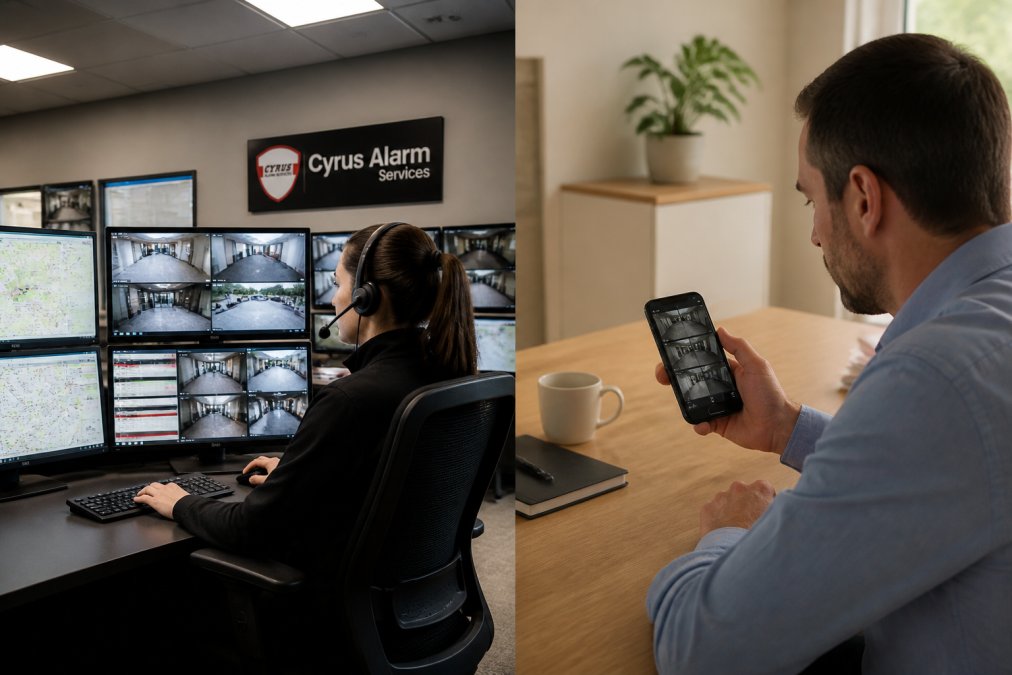
Professional monitoring means a trained operator at a 24/7 center watches alerts and responds on your behalf. Self-monitoring means you receive alerts on your phone and handle response yourself.
The key difference is response speed and liability. Professional services verify threats and contact authorities within minutes automatically. With self-monitoring, you're responsible for calling police; missed or delayed alerts mean delayed response. For commercial properties with valuable inventory or after-hours operations, this matters significantly.
Professional monitoring provides legal documentation, alert records, timestamps, and verification processes, critical for liability defense. Self-monitoring puts that burden on you.
Professional monitoring adds monthly fees; self-monitoring is cheaper upfront but requires constant attention. Most commercial properties choose professional monitoring because liability risk and response gaps outweigh savings.
Commercial Security System Pricing and Cost Factors
Pricing for business alarm system monitoring depends on property size, sensor/camera count, installation needs, and service level. However, factor in insurance premium reductions, which often offset or exceed annual monitoring costs.
Equipment and Installation Costs
Equipment costs vary: basic hardwired systems cost less than wireless systems with cameras and smart locks. Wireless offers flexibility but higher upfront costs. Cloud storage fees increase with retention length.
Commercial properties typically require professional installation to ensure proper placement, system integration, and code compliance.
Monthly Monitoring Service Fees
Monthly fees depend on service level. Basic intrusion detection costs less than plans with video verification and access control. Tiered plans let you start with essentials and add features as needs grow.
Annual commitments offer better rates than month-to-month agreements. Early termination fees vary; some charge substantial penalties, others offer flexible terms.
Insurance Premium Reduction: The Hidden ROI
Most business owners overlook the largest financial benefit: insurance premium discounts. Carriers offer 5-15% reductions when monitored by UL-certified or FM-approved centers. A 10% discount on $50,000 annual insurance equals $5,000 per year.
To qualify, your monitoring center must be UL-certified or FM-approved, both require rigorous testing for response time, reliability, and documentation. Verify certification before signing.
Example: $40,000 annual insurance with 10% discount = $4,000 savings. Monitoring costs $600/year. Net savings: $3,400/year or $10,200 over three years, covering equipment, installation, and service.
Carriers offer additional discounts for video verification (2-5%), access control (3-8% liability), and fire/life safety monitoring (5-10% fire insurance).
To claim discounts, request a monitoring certificate from your provider showing UL/FM certification, response time guarantee, and monitored threat types. Your agent applies the discount.
Total Cost of Ownership
Calculate three-year cost of ownership: equipment + installation + (monthly monitoring × 36) − (annual insurance savings × 3). Plans appearing expensive often become cost-neutral with insurance savings.
At Cyrus Alarm Services, we work with you to understand your specific needs and build a custom plan that covers what matters most for your business. We help you document your system for insurance discount claims, ensuring you capture the full financial benefit of professional monitoring.
Business Alarm Monitoring Contract Length and Terms
Most business alarm system monitoring contracts run one to three years. Shorter terms cost more monthly; longer terms lock in lower rates but require bigger upfront commitment.
Understand early termination fees, some charge flat penalties, others calculate based on remaining balance. Month-to-month options cost 20-30% more monthly than annual plans.
Review what happens if the monitoring center fails to respond or service is interrupted. Most limit liability, but some offer better service level guarantees with specific response times and credits for missed targets.
Understand renewal terms. Some auto-renew at higher rates; others let you renew at current pricing or shop around. Know the process upfront to prevent surprise increases.
Key Features That Matter in Monitoring Plans
Real-time mobile alerts are essential. Instant notifications let you check feeds, contact the center, or respond immediately.
Video verification reduces false alarms and police response costs by confirming threats before dispatch. Many jurisdictions charge false alarm fees, making verification essential.
Access control integration lets you manage entry remotely via smart locks. Grant or revoke access for temporary crews and cleaning staff without being on-site, preventing break-ins and theft.
Two-way voice communication lets operators confirm situations or warn off intruders through speakers, adding response capability silent alarms lack.
Audit logs track access, alerts, and system changes, critical for investigating theft, monitoring employee behavior, and proving compliance.
Mobile apps let you check feeds, arm/disarm, review alerts, and manage permissions from anywhere. Grant temporary access to service providers remotely.
Cybersecurity Features: Protecting Your System from Network Attacks
Connected alarm systems integrated with apps, cloud storage, and business software become cyberattack targets. Compromised systems expose property layout, access patterns, feeds, and logs to criminals or competitors, a critical concern many overlook.
Ask your monitoring provider about these cybersecurity protections:
Encryption in Transit and at Rest. Data between property, center, and app should use TLS 1.2+ encryption; cloud video should use AES-256. Encrypted data is useless if intercepted or breached.
Multi-Factor Authentication (MFA). Require codes sent to your phone or generated by authenticator apps, preventing access even if passwords are stolen. Essential for administrative accounts.
Regular Security Updates and Patch Management. Ask how often your provider patches vulnerabilities and whether updates are automatic. Unpatched systems accumulate exploitable flaws.
Network Segmentation. Alarm systems should operate separately from main IT infrastructure, preventing compromised alarms from exposing POS systems or databases. Confirm integrations use secure APIs without shared credentials.
Intrusion Detection and Monitoring of the Monitoring System Itself. Ask whether your provider uses intrusion detection systems (IDS) and conducts regular security audits or penetration testing.
Data Retention and Deletion Policies. Ask retention periods for footage, logs, and alerts. Longer retention increases hacker targets. Confirm providers actually delete old data, not just mark it deleted.
Compliance with Industry Standards. Regulated industries (healthcare, finance, retail) require HIPAA, PCI-DSS, or SOC 2 compliance. Confirm your provider meets relevant standards.
Vendor Security Assessments. Request SOC 2 reports, incident response plans, and breach notification policies before signing. Reputable providers share this documentation.
Cybersecurity is foundational to protecting your business. A monitoring plan is only as good as the security protecting its data.
Best Practices for Commercial Alarm Maintenance and System Health
Test your system regularly, monthly is ideal. Walk through the property and trigger each sensor to confirm it's communicating with the control panel. Check that alerts reach your phone and the monitoring center. A system that hasn't been tested is a system you can't trust when an emergency happens.
Keep your contact information current. If the monitoring center can't reach you when an alarm is triggered, response is delayed. Update your phone number, email, and authorized contacts whenever they change. Verify that the monitoring center has a backup contact if you're unreachable.
Review your camera footage periodically. Check that angles are clear, lighting is adequate, and video quality is sharp enough to identify faces and details. Adjust camera positions if blind spots develop. Replace lenses if they become dirty or fogged.
Test your backup power systems. If the main power fails, your security system should switch to cellular backup and battery backup. Verify that this happens automatically and that the monitoring center receives the power failure alert. A system without backup power is vulnerable during outages.
Update your access control permissions as staff changes. Remove access for employees who leave.
How to Choose the Right Monitoring Plan for Your Business
Start by assessing your actual risk. A retail storefront has different security needs than a warehouse or an office building. High-value inventory requires camera coverage and video verification. After-hours access requires access control. Multiple locations require multi-site management capabilities.
| Feature | Basic Plan | Professional Plan | Enterprise Plan |
|---|---|---|---|
| 24/7 Monitoring | Yes | Yes | Yes |
| Video Verification | No | Yes | Yes |
| Mobile App Access | Limited | Full | Full |
| Access Control | No | Optional | Included |
| Multi-Site Management | No | Up to 5 | Unlimited |
| AI-Driven Alerts | No | No | Yes |
| Response Time | 10-15 min | 5-10 min | 2-5 min |
Frequently Asked Questions
What factors influence the cost of business alarm monitoring plans?
Cost depends on system size, number of sensors and cameras, monitoring service type (professional vs. self-monitoring), contract length, and integration complexity. Businesses with multiple locations, video verification, and 24/7 professional monitoring typically pay more. Installation costs, equipment, and add-on features like access control also affect total pricing. Contact Cyrus Alarm Services for a custom quote based on your specific business needs.
What is the difference between cellular and broadband alarm monitoring?
Broadband monitoring uses your internet connection to transmit alerts, offering faster speeds but vulnerability if your internet goes down. Cellular backup provides redundancy through a dedicated cellular connection, ensuring alerts reach monitoring centers even during internet outages. Many modern business alarm system monitoring plans include cellular backup as standard for reliability. Professional monitoring centers can receive alerts through either method, but cellular ensures continuous protection during power or connectivity issues.
Is professional monitoring required for commercial insurance compliance?
Many commercial insurance policies require or offer discounts for professional 24/7 monitoring. Some policies mandate specific monitoring standards or certification levels. Check your business insurance policy and speak with your insurance provider about monitoring requirements. Professional monitoring with real-time alerts and response capabilities often qualifies for premium reductions, making it a financially smart choice beyond just security benefits.
What is the typical contract length for commercial alarm monitoring?
Commercial alarm monitoring contracts typically range from month-to-month agreements to 3-year terms. Longer contracts often come with lower monthly rates, while shorter terms offer flexibility. Early termination fees vary widely depending on the provider and contract type. Evaluate your business stability and security needs before committing to a contract length. Cyrus Alarm Services can discuss contract options that match your business timeline and budget.