 ultimate-guide
Temporary Site Security for Construction: A Practical Guide
Last Updated: October 30, 2026
Quick Summary
Temporary site security for construction is the set of fencing, lighting, cameras, access controls and monitoring that protects a jobsite before a permanent building exists. Planning it phase by phase, before the first excavator arrives, prevents the theft, vandalism and liability losses that often set schedules back by weeks.
- Theft of tools, copper wire and fuel is common, and vandalism tends to spike on idle weekends and holidays.
- Keep a one-page risk register recording each phase's primary risk, control, accountable person and change trigger.
- Assign named people to controls, such as a specific person checking the gate log every Friday.
- Place cameras to cover the main gate and material yard, with overlapping views to reduce blind spots.
- Pre-register delivery trucks and contractor vehicles, and log plate numbers at the gate.
Table of Contents
- Why Temporary Site Security Matters on Construction Projects
- Building a Construction Site Security Plan by Project Phase
- Perimeter Protection: Fencing, Barriers and Lighting
- Temporary Construction Security Cameras and Camera Placement
- Construction Site Access Control for Workers, Visitors and Vehicles
- Integrating Construction Cameras with Access Control Systems
- Booking a Temporary Security Assessment for Your Next Jobsite
- Frequently Asked Questions
Temporary site security for construction is one of the most overlooked costs on a build, and it is usually discovered after something goes missing. A copper spool stripped overnight, a telehandler taken from an unfenced lot, or a half-framed house vandalized over a holiday weekend can each set a schedule back by weeks. The sites that lose the least are generally the ones that planned security before the first excavator arrived. This guide walks through how to do that, phase by phase.
Why Temporary Site Security Matters on Construction Projects
Temporary site security is the set of fencing, lighting, cameras, access controls and monitoring that protects a jobsite while it has no permanent building to protect it. Unlike a finished property, an active construction site is open, changing daily and full of portable, high-value material.
The risks are predictable. Theft of tools, copper wire and fuel is common, and vandalism tends to spike when a site sits idle over weekends or holidays. Unauthorized entry also creates liability: an unsecured excavation or stack of materials that injures a trespasser can become your problem. Insurers and general contractors increasingly ask what protection is in place before they will accept a risk.
Many contractors treat security as an add-on once theft has already happened. A better approach is to price it in from the start, as part of the project's site setup and not an emergency expense.
Building a Construction Site Security Plan by Project Phase
A construction site is not equally vulnerable at every stage, so a single fixed setup rarely fits the whole project. The most effective approach is a construction site security plan that changes as the work moves forward.
Start with a one-page risk register. For each phase, record four things: the primary risk, the control in place, the person accountable, and the trigger that tells you to change the setup. Keep it short enough that a superintendent will actually update it.
- Site preparation and excavation: Exposure is highest here because equipment is delivered and staged while the site is still open. Prioritize perimeter fencing, lighting and camera coverage at the access point. Assign a single person to confirm the gate is locked at the end of each shift, and log the check. This is also the phase to photograph every delivered item and record serial numbers, because recovery after a theft depends on being able to prove what was taken.
- Framing and structure: Materials arrive in volume and tools are used across many trades. Add access control for workers and vehicles, and inventory high-value items each day. A common pattern is a five-minute end-of-shift walk that checks gates, storage containers, and any equipment left outside. Rotate who performs the walk so it does not become one person's skipped routine.
- Enclosure and mechanical work: Copper, fixtures and appliances become targets once they are installed but before the building is occupied. Keep cameras focused on storage areas and interior entry points. This is the phase to move temporary cameras inside the structure as walls go up, because exterior coverage no longer sees what is happening in finished rooms.
- Finishing and handover: Theft shifts toward finished fixtures and tools that are moved out late in the project. Review and adjust coverage as crews change. Reduce the footprint of stored material and schedule deliveries so high-value finishes arrive close to installation rather than sitting on site for weeks.
Write the plan down, and give it a review cadence. A short weekly review at the same meeting where you discuss schedule and safety keeps security from being forgotten when the project falls behind. When a phase changes, update three things: the camera positions, the access rules, and the list of people who receive alerts.
Document the plan for your insurer and general contractor as well. Many carriers and GCs ask for a written site security plan before they will accept the risk, and a phase-based document with named responsibilities is easier to defend than a verbal assurance that the site is fenced.
Perimeter Protection: Fencing, Barriers and Lighting
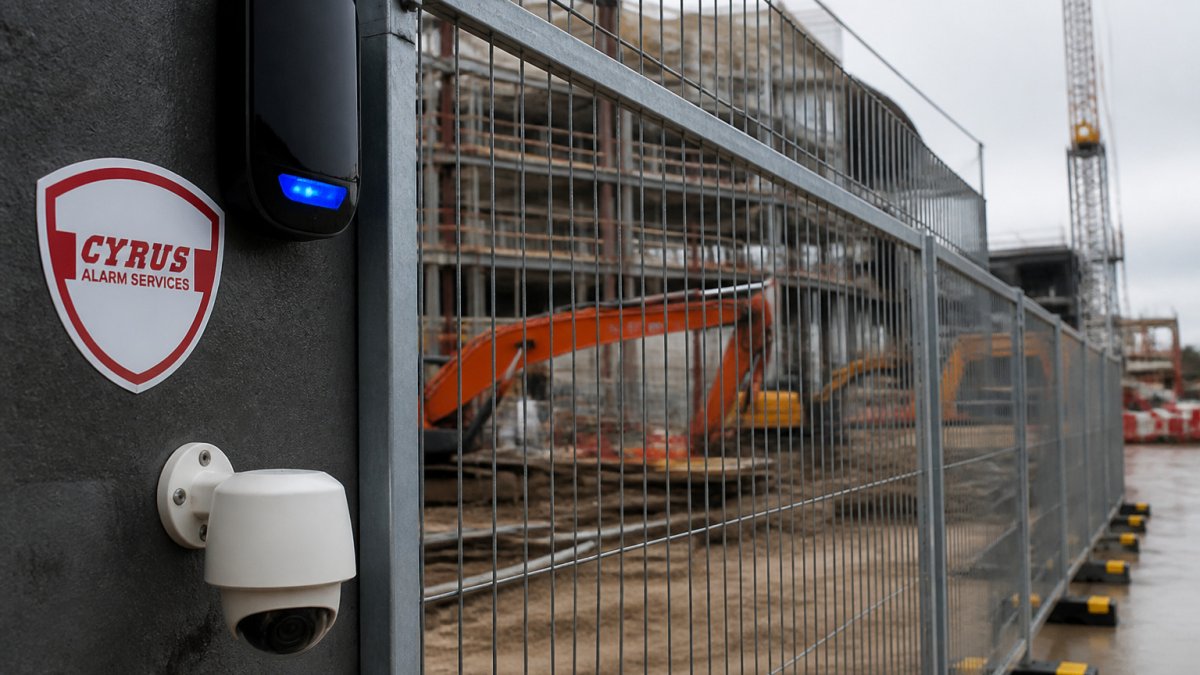
Perimeter fencing is the first line of defense and the easiest to deploy quickly. Temporary panel fencing set on weighted bases can be installed without digging, which matters on sites where utilities or future foundations are still unknown. Solid screening on the fence line also limits what a passerby can see of stored equipment.
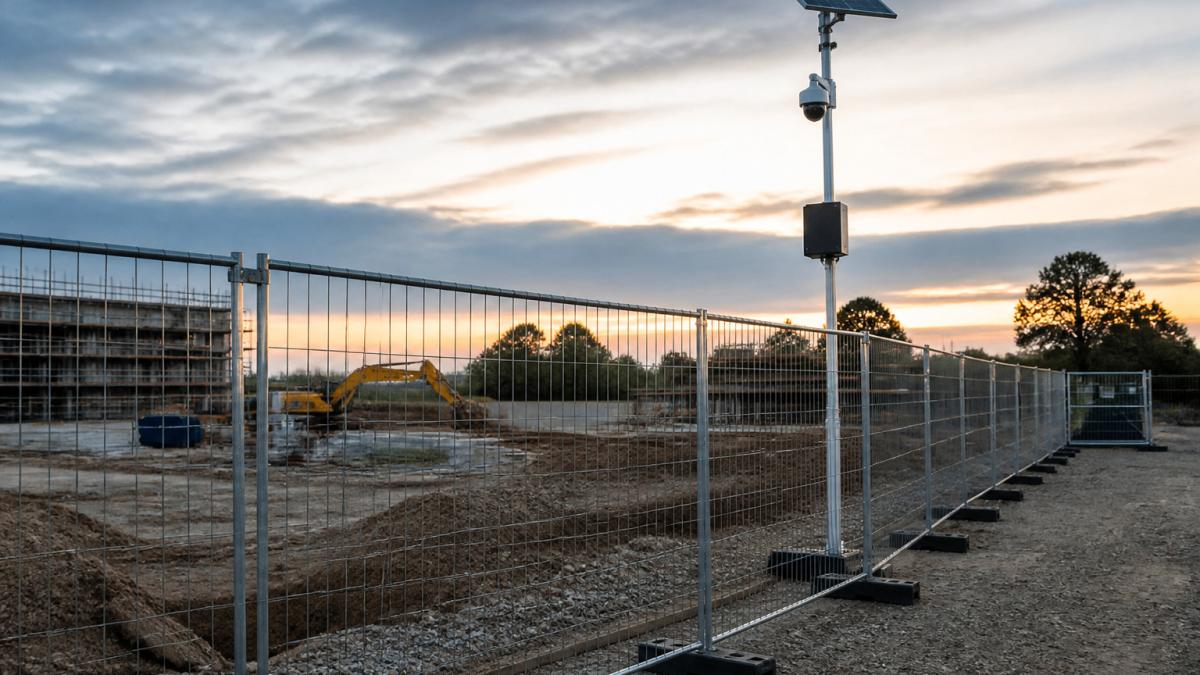
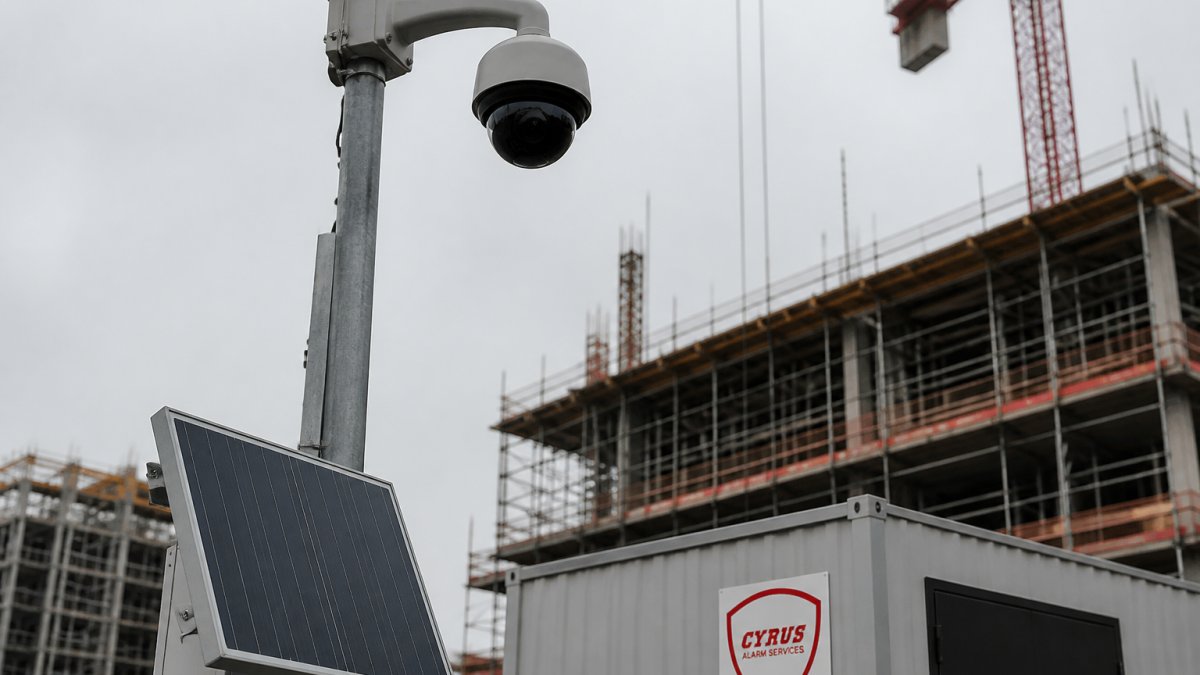
Lighting is often underestimated. A dark site invites entry, and a well-lit perimeter makes intruders more visible to cameras and neighbors. Motion-activated floodlights tend to be more effective than constant lighting, because they draw attention when activity occurs. Solar-powered units are useful on remote or unwired lots where running power is not yet practical.
Barriers at the vehicle entrance matter as much as the fence. Bollards or a retractable barrier stop a vehicle from driving straight onto the site, and warning signs stating that the site is monitored deter casual trespassing.
Temporary Construction Security Cameras and Camera Placement
Temporary cameras are generally easier to manage when they are relocatable and able to send footage off site.
Before choosing equipment, run a short deployment checklist. Confirm where power is available and whether it will still be there next month. Test cellular signal at the actual camera location, not at the site trailer.
Placement determines whether footage is useful. Cover the main gate, the material staging area and any doorway into a partially enclosed structure.
Footage is only valuable if you can read it. Cameras mounted too high, pointed into glare or set without enough resolution to identify a face or license plate will record activity without helping you act on it.
Live monitoring adds a response layer that recording alone does not provide. Remote monitoring lets an operator check flagged activity in real time and contact the right person or police quickly.
The article's key camera deployment checks and what each one protects against are summarised below.
| Check | Why it matters | Source point |
|---|---|---|
| Power availability | Confirms the unit keeps running next month | Run before choosing equipment |
| Cellular signal at camera | Ensures footage uploads reliably | Test at the camera, not the trailer |
| Access points | Counts every way in, including fence gaps | Include unguarded sides |
| Retention period | Drives storage and cost | Set before purchase |
| Blind spots | Shows where thieves will work | Check behind stacked material |
| Overlapping views | Covers one camera's blind spot | Overlap gate and material yard |
| Night test | Confirms footage is readable | Done before the camera is considered finished |
Construction Site Access Control for Workers, Visitors and Vehicles
Access control answers a simple question: who is on the site and when. On most projects, there are three groups to manage: crews with badges or assigned hours, visitors such as inspectors and deliveries, and vehicles.
Set a single controlled entry point wherever possible. A gate with a keypad, a badge reader or a logged check-in sheet creates a record of who came in.
Vehicle control is often the weakest link. Pre-register delivery trucks and contractor vehicles, and log plate numbers at the gate. When crews leave, confirm that the gate closes and locks behind them, because a gate left open is one of the most common causes of after-hours losses.
Keep the rules short and posted at the gate so every worker and visitor sees the same expectations. Access control only works if it is enforced consistently.
Integrating Construction Cameras with Access Control Systems
Cameras and access control work best when they feed each other. An access event, such as a badge scan at the gate or a keypad entry after hours, can trigger a camera to record or flag the person in the frame. That links the identity recorded at the gate with the footage showing what happened inside the site.
Integration also simplifies investigation. If a piece of equipment goes missing, you can search for access events in the relevant window and review matching footage without scrolling through hours of video.
Before integrating, confirm that the access control panel, cameras and monitoring service can share data. Mismatched platforms create manual steps that are easy to skip under pressure.
Booking a Temporary Security Assessment for Your Next Jobsite
The most useful next step is an assessment before the site opens. A site walk-through can identify your access points, blind spots, lighting gaps and high-value storage areas, and turn them into a phased plan with equipment sized to the project.
Ask any provider for a written deployment plan that covers equipment, monitoring hours, response procedures and how the system is removed or moved when the job ends. Confirm who on your team receives alerts and how incidents will be documented for your insurer.
For questions about security for an active or upcoming jobsite, contact Cyrus Alarm Services for a quote. Pricing depends on quantity, duration, and delivery, so request a quote for your specific site.
Frequently Asked Questions
What is the best way to secure a construction site temporarily?
Combine a fenced perimeter with weighted bases, lighting, and a monitored camera system that can be moved as the project progresses. Add access control at the gates so only authorized workers and vehicles enter. Pricing depends on quantity, duration, and delivery, so request a quote for your specific site.
What security measures should a construction site have?
Most jobsites need four layers: a physical perimeter, visual deterrence such as signage and lighting, electronic monitoring through cameras and intrusion alarms, and controlled access for people and vehicles. Tool and copper storage should be locked and inventoried. Many sites also use mobile patrols or on-site guards during off-hours, especially during the early excavation and framing phases when materials are most exposed.
How can construction site cameras work with access control?
Confirm with any vendor whether camera and access control systems can share a platform before purchase.
How do you prevent theft at a construction site?
Start with a site inventory that records serial numbers and photographs of high-value tools and equipment. Store small items in locked containers or trailers, secure copper wire and fixtures until they are installed, and keep lighting on during non-working hours. Monitored cameras and alarms deter most opportunistic theft, while regular walk-throughs by a supervisor help catch problems early.
Are temporary security cameras effective on construction sites?
Yes, when they are placed to cover entry points, material storage, and blind spots behind equipment or temporary structures. Cameras with night vision and live remote monitoring give the most value because they allow a response before losses occur. Recorded footage also helps with insurance claims and incident reporting. Camera effectiveness depends on coverage design, so a site survey before installation is worthwhile.
How long should temporary construction site security stay in place?
Keep security in place until the building is enclosed, all high-value materials are installed, and the site is handed over or occupied. Many projects reduce coverage in later phases rather than removing it entirely. Equipment that is rented can often be scaled down or moved to another jobsite. Review the security plan at each phase change, since risk shifts from excavation to framing to finishing work.
What should a construction site security plan include?
A useful plan lists the risks for each project phase, the perimeter and camera layout, access rules for workers and vehicles, lighting and alarm schedules, an equipment inventory, and an incident reporting workflow. It should also name who responds to alarms and how footage is stored and shared. Reviewing the plan monthly with the site superintendent keeps it aligned with actual conditions.