 ultimate-guide
Integrated Security System Design Guide for Homes and Businesses
Quick Summary
An integrated security system is a single platform that connects intrusion alarms, video surveillance, access control, and monitoring so they share data and respond together through one interface. Unlike a standalone system that only reports that something happened, it shows what happened and lets you act on it.
- Layer detection by pairing perimeter door and window contacts with interior motion sensors.
- Place identification cameras at primary entries and asset areas, and detection cameras on yards and parking lots.
- Keep card readers and keypads at choke-point doors rather than at every interior door.
- Confirm the locally adopted codes, since they can be stricter than NFPA 731 and NFPA 72.
- Budget for backup power, a secondary communication path, and local recording in case the cloud link drops.
Table of Contents
- What an Integrated Security System Is and Where It Fits
- Integrated Security System Components and How They Connect
- Security System Design Process: From Risk Assessment to Layout
- Cost, Lifecycle Planning and Return on Investment
- Security System Installation Checklist
- Security System Maintenance and Testing Schedule
- Booking Your Integrated Security Consultation with Cyrus Alarm Services
- Frequently Asked Questions
What an Integrated Security System Is and Where It Fits
An integrated security system is a single platform that connects intrusion alarms, video surveillance, access control, and monitoring so they share data and respond together through one interface. At Cyrus Alarm Services, we design alarm systems for homes and businesses.
A standalone system tells you something happened; an integrated one shows you what happened and lets you act.
Integrated Security System Components and How They Connect
- Control panel: The brain of the system. It receives signals from every device, applies arming schedules, and routes alerts.
- Intrusion sensors: Door and window contacts, motion detectors, glass-break sensors, and shock sensors.
- Cameras: IP cameras handle video surveillance and CCTV recording.
- Access control: Keypads, key fobs, smart locks, and door readers that control who can enter and when.
- Life-safety devices: Smoke, heat, and carbon monoxide detectors integrated into the same panel so fire and environmental alerts reach the same monitoring workflow as intrusion events.
- Communications: Cellular and internet pathways that carry signals to the monitoring center, with a backup path so a severed line does not silence the system.
- Mobile app and cloud platform: Remote management via mobile apps.
Security System Design Process: From Risk Assessment to Layout
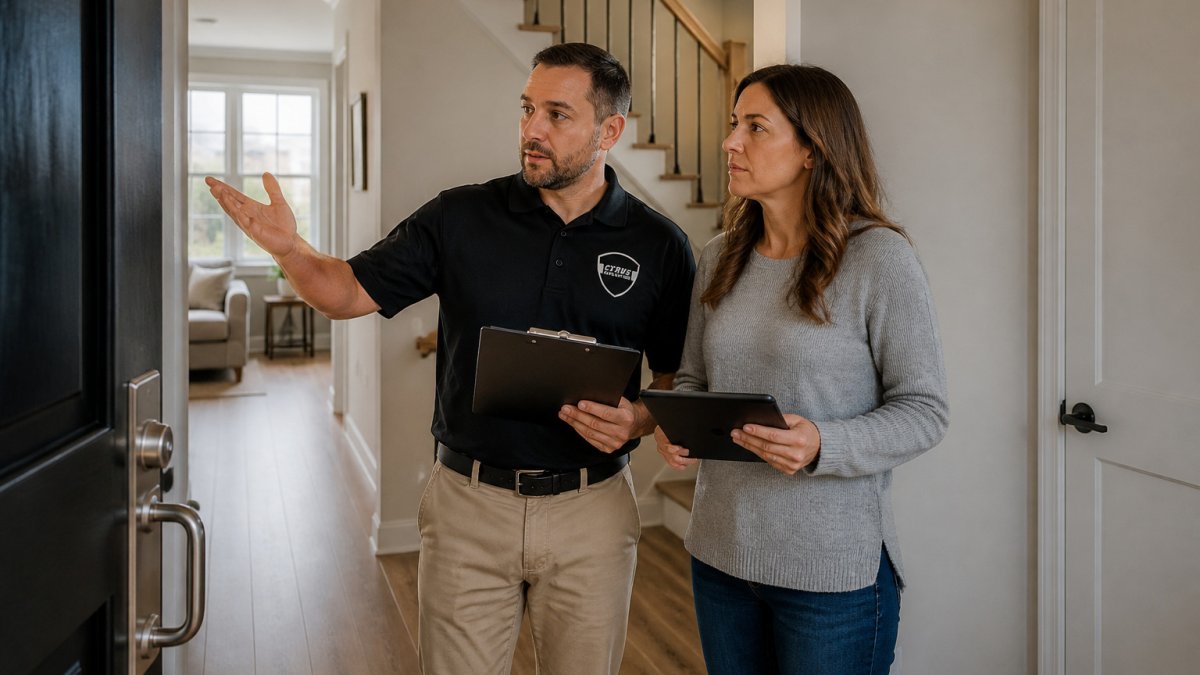
A security consultant and a homeowner walking through a two-story house with a clipboard and tablet, reviewing entry points and camera placement.
Assessing Risks and Setting Requirements
Begin by listing what needs protecting and the threats most likely to target it. A home with young children may rank life-safety monitoring first; a small business usually prioritizes after-hours intrusion detection and visible CCTV.
Translating Requirements into a Layout
- Perimeter first, interior second. Put contacts on every ground-floor opening and every opening to a sensitive area, then add motion coverage for interior paths. A door sensor tells you someone entered; hallway motion tells you where they went.
- Layer the detection. Pair perimeter contacts with interior motion and, for high-value rooms, glass-break or shock sensors. A single layer is easy to defeat; overlapping layers force an intruder to trigger more than one sensor.
- Place cameras to identify, not just observe. A camera showing a figure at 40 feet is a detection camera; one showing a face at the door is an identification camera. Put identification cameras at primary entries and asset areas, and wider detection cameras on parking lots, yards, and long corridors.
- Watch the light. Point cameras away from direct sun and strong backlight at entries; a camera facing a bright doorway at dusk will silhouette every visitor.
- Respect the dead zones. Motion detectors have blind spots directly below and to the sides. Overlap coverage between adjacent detectors so no path goes unseen.
- Keep access control at the choke points. Card readers and keypads belong at the doors that everyone must pass through, not at every interior door. Fewer, well-placed readers are easier to manage and cheaper to maintain.
Mapping Design Decisions to Standards and Codes
- NFPA 731 covers the installation of premises security systems and is the usual reference for wiring, device placement, and system performance (NFPA 731 Standard for the Installation of Premises Security Systems).
- NFPA 72 governs fire alarm and signaling, and it matters whenever smoke or carbon monoxide detection shares a panel with security functions (NFPA 72, National Fire Alarm and Signaling Code).
- NFPA 101 (Life Safety Code) drives egress requirements, which constrain how access-controlled doors may lock and how they must release on fire alarm.
- ADA Standards for Accessible Design affect the height and operability of readers, keypads, and door hardware on accessible routes.
- Local building and fire codes adopted by the authority having jurisdiction can be stricter than the model codes, so confirm the adopted edition before finalizing the specification.
Network Architecture, Cybersecurity and Privacy Planning
Privacy planning matters too. Decide in advance where cameras may point, who can view recordings, and how long footage is retained; recording a neighbor's yard or an employee break room creates legal and trust problems far cheaper to avoid during design. Document the retention period and deletion process, and confirm the policy against applicable state privacy and biometric laws before enabling facial recognition or biometric access.
Cost, Lifecycle Planning and Return on Investment
Cyrus Alarm Services does not publish fixed prices in this guide, so request a site-specific quote for current figures. To compare recurring expenses, see business alarm monitoring plans.
Breaking the Cost into Line Items
- Equipment: panels, sensors, cameras, recorders, readers, locks, and cabling or wireless modules. For a breakdown of camera costs, see the full pricing guide for professional CCTV installation.
- Installation labor: mounting, wiring, configuration, and any drywall or conduit work.
- Network and IT work: switches, VLAN configuration, firewall rules, and any cabling the IT side must own.
- Monitoring: the recurring monthly service, including the communication path (cellular, internet, or both).
- Software and cloud: per-user or per-device subscriptions, storage for recorded video, and any integration licensing.
- Training and documentation: owner training, as-built drawings, and the written handover package.
Total Cost of Ownership
Plan camera replacement on a shorter cycle than the panel, and treat batteries as consumables with a scheduled replacement date. Ask each vendor two questions that reveal real lifecycle cost: how long will this platform receive firmware and security updates, and can components be added or replaced later without replacing the panel? A platform that stops receiving updates becomes a liability, not an asset.
Return on Investment
In homes, the return is harder to quantify but often shows up as fewer false dispatches and the ability to verify an alarm remotely before acting. A verified alarm you can cancel before responders roll saves money and keeps you in good standing with the monitoring service and local authorities.
Resilience, Redundancy and Continuity
Budget for continuity, not just detection. A system that goes dark during a power outage or internet failure protects nothing. Plan backup power on the panel and network gear, a secondary communication path (cellular alongside internet), and a recorder that keeps recording locally if the cloud link drops. Test failover on a schedule and include recovery testing in the annual service visit.
Integration Testing and Acceptance
Tie final payment to measurable acceptance criteria. Before handover, require the installer to demonstrate that a door contact triggers the correct camera, the clip is stored for the agreed retention period, the access event appears in the audit log, and the monitoring center confirms a test signal. Set response-time targets in the contract, such as time from sensor trip to alert delivery, and test them. A commissioning checklist with pass/fail results is the difference between a system that was installed and one that was proven.
Security System Installation Checklist
- [ ]
- [ ]
- [ ]
- [ ]
- [ ]
- [ ]
- [ ]
- [ ]
- [ ]
- [ ]
Security System Maintenance and Testing Schedule
Testing also reduces false alarms, which waste responder time and can lead to fines in some jurisdictions. For practical steps to stop false alarm triggers, see how to reduce false alarm triggers. Recurring nuisance triggers usually trace to a loose contact, a pet entering a motion zone, or a sensor near a heat vent. Fix the zone or sensor placement rather than simply raising sensitivity. For more on routine upkeep, read our [page:1] and our [page:2].
The article's testing and maintenance guidance is easier to scan in the following form.
| Item | Value | Note |
|---|---|---|
| Testing purpose | Reduces false alarms | Wastes responder time; may lead to fines |
| Common nuisance cause | Loose contact | Also pets in motion zones, sensors near heat vents |
| Preferred fix | Adjust zone or sensor placement | Rather than simply raising sensitivity |
Booking Your Integrated Security Consultation with Cyrus Alarm Services
At Cyrus Alarm Services, we provide custom consultation, installation, and servicing. We rigorously test every device in-home. Our family-owned business supports full Alarm.com integration. Ready to move forward? Get a quote.
Last Updated: October 28, 2026
Frequently Asked Questions
What is an integrated security system?
An integrated security system connects alarms, video surveillance, access control, intrusion detection and communications under one platform so devices share events and can be managed from a single interface.
What components make up an integrated security system?
Most integrated security systems include a control panel, door and window sensors, motion detectors, cameras, access control readers or smart locks, keypads, sirens, and a communication path such as cellular or broadband. Some designs add smoke and carbon monoxide devices for life safety, plus automation modules for lights and thermostats. Each component should be selected for compatibility with the central panel so events reach a single monitoring point.
How do access control, video surveillance, and alarms work together?
When integrated, these subsystems share triggers and records. For example, a door forced open after hours can start camera recording, send an alarm signal to the monitoring center, and lock a credential out of the system until staff review the event. Video footage can be tagged with access logs so investigators can match a badge swipe with a clip. This coordination reduces false alarms because a verified event, such as a person seen on camera, can be prioritized over a single sensor trip.
Can an integrated security system connect to smart home devices?
Yes, many integrated systems support smart locks, thermostats, lighting and garage door controls through the same app used for alarms. Compatibility depends on the panel and the protocols the devices use, so confirm supported brands before purchase. Connecting smart devices lets you lock doors, check cameras and adjust settings remotely, which is useful for families who travel or property owners who manage more than one site.
How do you maintain and test an integrated security system?
Test the system at least monthly by triggering each sensor, confirming the panel reports the event, and verifying that monitoring receives the signal. Check camera image quality, clean lenses, confirm recording storage, and update firmware on panels and cameras when the manufacturer releases patches. Battery backup should be tested and batteries replaced on the manufacturer's schedule. Keep a written log of tests and service visits so you can show the system was maintained.
What should you consider when choosing an integrated security system?
Start by identifying entry points, high-value areas and the threats you most need to address, such as burglary, fire or unauthorized access to a job site.
How much does it cost to install an integrated security system?
Cyrus Alarm Services does not publish standard prices in this guide. Visit the Cyrus Alarm Services website or request a quote for current pricing.