 blog
blog
Vivint vs ADT for Business: 2026 Comparison
Table of Contents
- Vivint vs ADT for Business: Overview and Verdict
- Equipment and Hardware Comparison
- Business Alarm Monitoring and Response
- Business Security Camera Systems and Video Analytics
- Commercial Security System Costs: Installation, Monitoring, and Contracts
- Scalability, Integration, and Business Continuity
- Best Business Security Systems: Which One Fits Your Operation
- Frequently Asked Questions
Last Updated: October 5, 2026
Vivint vs ADT for Business: Overview and Verdict
Choosing a business security system means weighing two fundamentally different approaches. At Cyrus Alarm Services, we work with business owners, and the question of vivint vs adt for business comes up constantly. Both offer professional monitoring, video surveillance, and intrusion detection, but they serve different business types and priorities.
ADT has dominated commercial security for decades with established relationships and broad service availability. Vivint brings newer technology, AI-powered video analytics, and aggressive pricing aimed at smaller operations. Neither is universally "better", the right choice depends on your needs, budget, and growth plans.
This guide breaks down the real differences across equipment, monitoring, costs, and scalability so you can make an informed decision for your business.
Equipment and Hardware Comparison
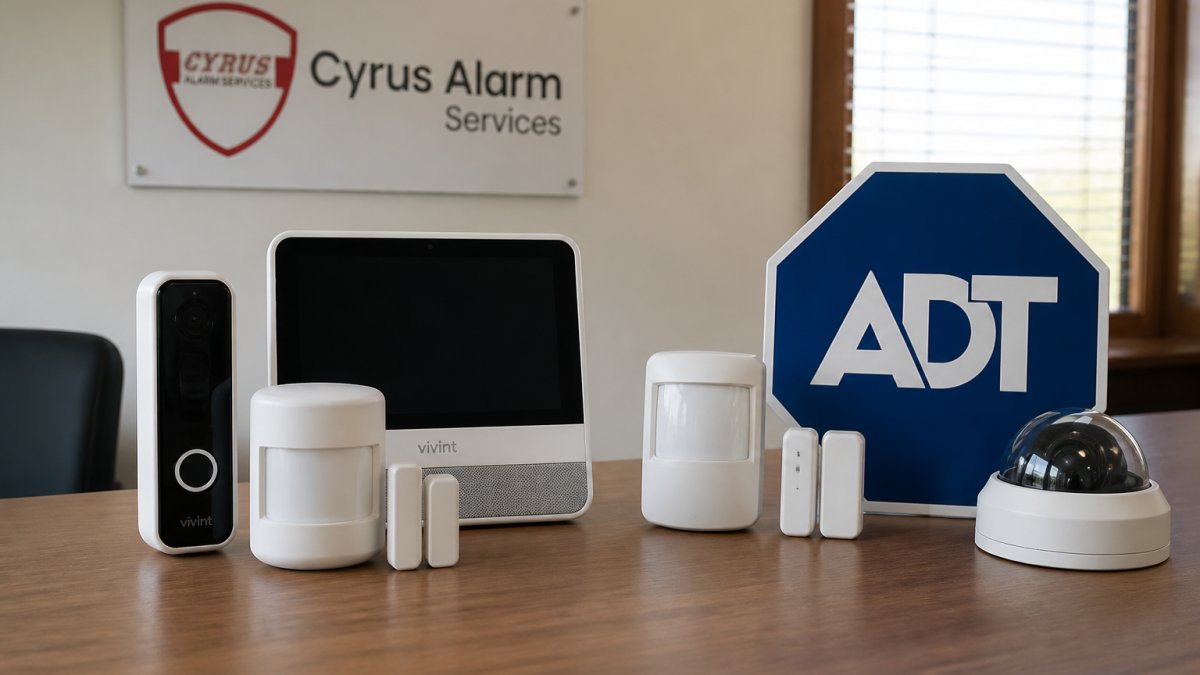
Both offer professional-grade equipment, but their approaches diverge. ADT relies on traditional hardwired and wireless sensors with established monitoring protocols, emphasizing reliability and compatibility with existing infrastructure, which matters when upgrading an older building with unconventional wiring.
Vivint emphasizes integrated smart technology and AI-powered cameras designed to work together through a single platform. If you want motion sensors, door and window sensors, and cameras communicating through one app, Vivint's ecosystem is more cohesive.
For businesses with multiple locations or complex access control needs, ADT's modular approach often wins. You can mix and match equipment from different product lines. Vivint's strength lies in single-site operations where you want everything integrated and simple.
Camera quality matters most for businesses relying on video evidence. Both offer HD and 4K, but Vivint's AI-powered cameras include person detection and activity classification, while ADT cameras require more manual review. If you need to identify who entered your facility at 2 AM, Vivint's analytics save hours of footage review.
Business Alarm Monitoring and Response
Professional monitoring is where the operational difference is largest. ADT operates monitoring centers nationwide with established dispatch protocols: when your alarm triggers, their center contacts you, verifies the alarm, and dispatches police if needed. Response time and protocol consistency are their strength.
Vivint uses third-party monitoring centers, which can create variability in response protocols, and some customers report longer peak-hour wait times. However, Vivint's monitoring costs are typically lower, appealing to price-conscious small business owners.
Both offer 24/7 professional monitoring for intrusion detection. The real difference is false alarm handling: ADT's long history with police departments means better relationships and faster response, while Vivint's cost-driven approach sometimes translates to lower false alarm penalties in certain jurisdictions.
If your business operates in a high-crime area or handles high-value inventory, ADT's established monitoring relationships provide meaningful peace of mind. If you're a small retail operation in a safer neighborhood, Vivint's monitoring quality is adequate and costs significantly less.
Business Security Camera Systems and Video Analytics
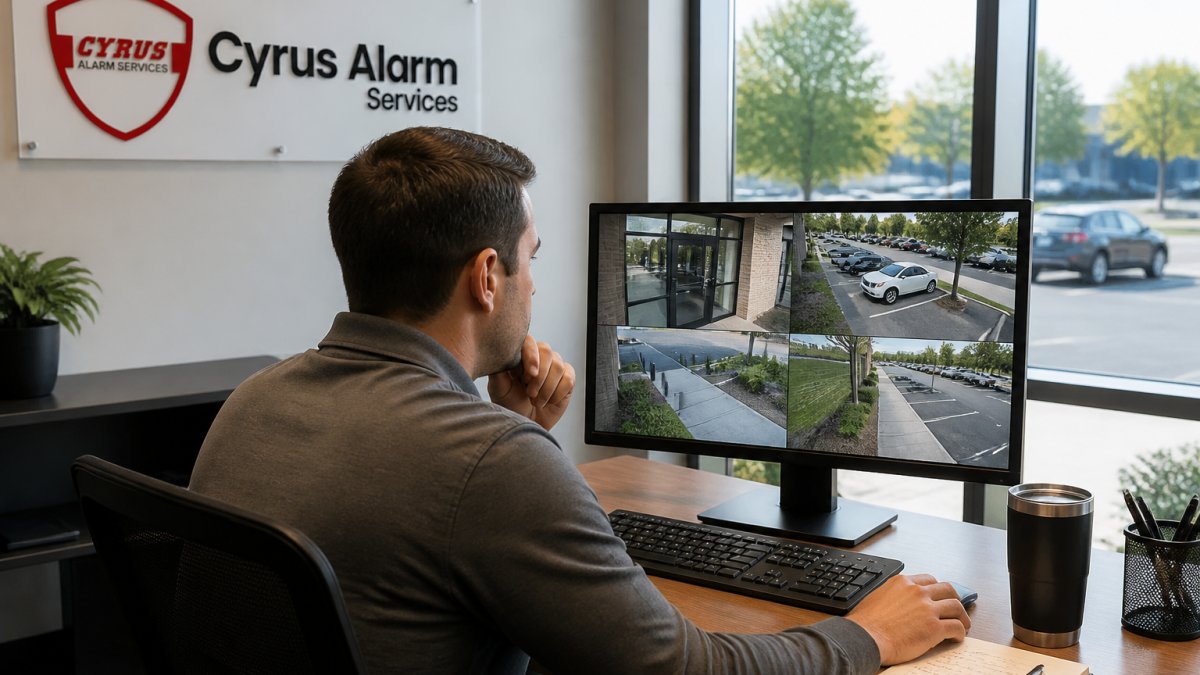
This is where technology divergence is most visible. Vivint's newer cameras include built-in AI that identifies people, vehicles, and unusual activity patterns, alerting you when someone enters your property rather than when motion is detected.
ADT's cameras capture high-quality video but rely on motion detection and manual review. If someone walks slowly across your parking lot, ADT alerts you to motion; Vivint alerts you to "person detected in parking area", requiring less human judgment to act on.
Cloud storage differs too: Vivint includes cloud backup as standard on most plans, while ADT often charges extra for extended storage.
For businesses with multiple cameras, Vivint's video analytics reduce alert fatigue: you get alerts for actual security events instead of motion triggers from windblown trees or passing delivery trucks.
Commercial Security System Costs: Installation, Monitoring, and Contracts
Residential pricing pages are a poor proxy for what a business pays. Commercial quotes are built line by line, and the two providers structure those lines differently. The table below shows the categories driving total cost of ownership; figures are typical ranges, not published rates, because both price commercial work custom.
| Cost category | ADT (typical commercial quote) | Vivint (typical commercial quote) |
|---|---|---|
| Upfront installation | Higher; often bundled into a multi-year agreement | Lower; frequently discounted or waived with a monitoring commitment |
| Panel and sensors | Proprietary hardware, leased in most agreements | Proprietary hardware, often financed to ownership |
| Cameras | Priced per camera; analytics may be a separate line | Priced per camera; AI analytics bundled on higher tiers |
| Monthly monitoring | Lower per-month base, longer term | Higher per-month base, shorter initial term |
| Cellular backup | Commonly included on commercial plans | Often an add-on |
| Service visits | Included under warranty; out-of-warranty billed per trip | Included under warranty; out-of-warranty billed per trip |
| Contract length | Typically 3 years, sometimes 5 for multi-site | Commonly 3-5 years with month-to-month options after |
| Equipment ownership | Provider retains ownership in most agreements | Financing option lets you own the hardware at payoff |
How to read that table as a business owner. The headline monthly rate is the least important number. What matters is the three-year all-in figure: upfront + (monthly × term) + realistic add-ons like cellular backup, extra cameras, analytics tiers, and service trips.
Contract mechanics that catch businesses off guard.
- Evergreen clauses. Some commercial agreements auto-renew for successive terms unless you give written notice in a defined window, often 30 to 90 days before expiration. Calendar that notice date the day you sign.
- Relocation clauses. If you move, the agreement may or may not transfer to the new address. Ask specifically whether relocation triggers a new installation charge or a new term.
- Early termination. Business agreements frequently include an early-termination fee equal to a percentage of remaining monthly payments. Get the formula in writing before you sign.
- Equipment return. If the provider owns the hardware, you are typically responsible for returning it in working condition at the end of the term. Missing equipment can be billed at replacement cost.
Financing and equipment ownership. Vivint's financing lets you pay the hardware off over time and own it, keeping the asset on your balance sheet and giving flexibility if you sell. ADT's lease-style model keeps hardware off your capital budget but means you never own it and may face return obligations.
Where business pricing diverges from residential. Residential plans are standardized and advertised; commercial plans are quoted based on square footage, entry points, camera count, access control integration, and number of sites.
For a quote tailored to your property, square footage, and device count, contact both providers directly or work with a professional integrator who can translate the quotes into an apples-to-apples comparison.
Scalability, Integration, and Business Continuity
A security system that works for one storefront can become a liability at three. These questions separate a system you can grow into from one you will rip out in 18 months.
Multi-site management. ADT's commercial platform centers on centralized account management: one dashboard, one billing relationship, and consistent monitoring protocols across locations, valuable when training managers to arm, disarm, and respond the same way. Vivint's strength is single-site depth, but managing five Vivint systems means five accounts, five apps, and five sets of permissions unless an integrator unifies them.
Access control and building system integration. If you run badge readers, a time-clock system, or a POS platform, ask both providers how their panels talk to those systems. ADT integrates more readily with enterprise access control and building management systems, which is why multi-location operations standardize on it.
Employee access permissions. Both systems let you assign user codes with schedules, a cleaning crew that can disarm only between 10 p.m. and 2 a.m., or a manager who can arm but not change settings.
Business continuity: what happens when things fail.
- Internet outage. Both systems can run on cellular backup, but ADT commonly includes it on commercial plans while Vivint often charges extra. If your business cannot tolerate a monitoring gap, treat cellular backup as mandatory, not optional.
- Power loss. Both offer battery backup. Ask for the rated backup duration in hours, not just "battery backup included." A system that runs 4 hours on battery behaves very differently from one that runs 24.
- Alarm verification. Many jurisdictions now require some form of verification, audio, video, or a second signal, before police dispatch. Confirm how each provider handles verification in your area, because an unverified alarm may not generate a police response at all.
- Service-level expectations. Ask each provider for their target response time for a service call, their after-hours support process, and how escalations work when a site goes down. Businesses that cannot afford downtime should get those commitments in writing.
Scalability checklist before you sign.
- Can I add cameras, sensors, or a new location without replacing the panel?
- Does the system support the access control or POS platform I already use?
- Can I export user activity and alarm logs for audits or insurance documentation?
- What is the rated battery backup duration, and is cellular backup included or an add-on?
- What is the contracted service response time, and how do I escalate a failure?
If you are unsure which path fits your operation, a professional integrator can map your current systems, growth plans, and downtime tolerance against both providers' commercial offerings before you commit to a multi-year agreement.
Best Business Security Systems: Which One Fits Your Operation
The right choice depends on your business profile. Choose ADT if you operate multiple locations, require enterprise-grade access control, or need proven relationships with local emergency services; its infrastructure and monitoring protocols suit growing businesses prioritizing reliability and scalability over modern features.
Choose Vivint for a single location with integrated smart technology, lower upfront costs, or AI-powered video analytics. It suits tech-forward small businesses wanting modern features without enterprise complexity.
For construction companies managing temporary job sites, Vivint's flexibility and lower installation costs often win. For established retail operations with multiple locations, ADT's proven systems and multi-site management typically deliver better long-term value.
Consider your local support needs too. Cyrus Alarm Services provides professional consultation for your security risks and budget. Professional installation ensures reliable operation from day one, whichever provider you choose.
Choosing between vivint vs adt for business requires understanding how each provider approaches security differently. ADT prioritizes proven reliability and scalability. Vivint emphasizes modern technology and cost efficiency. The best choice aligns with your business size, growth plans, and security priorities.
Frequently Asked Questions
Is Vivint or ADT better for a small business?
Neither Vivint nor ADT is universally better, it depends on your specific needs. Vivint excels for businesses requiring smart home integration and AI-powered video analytics, while ADT offers longer monitoring experience and broader commercial compliance certifications. Small businesses with multiple locations may prefer ADT's scalability; those needing integrated access control and remote management may favor Vivint. Request quotes from both and evaluate which aligns with your operational priorities.
What should a business compare before choosing a security system?
Evaluate these factors: total cost of ownership (equipment, installation, monthly monitoring, and contract terms), professional installation capability, monitoring center response time and certifications, video quality and cloud storage capacity, remote access reliability, scalability for future expansion, integration with existing business systems (access control, smart locks, automation), false alarm penalties in your jurisdiction, and warranty coverage. Also confirm the provider can handle your specific use case, temporary construction site security, multi-location management, or specialized compliance needs.
Do Vivint and ADT offer commercial security systems?
Both Vivint and ADT offer commercial security solutions, but their approach differs. ADT has a longer track record serving large enterprises and provides extensive commercial compliance certifications. Vivint's business offerings focus on smaller to mid-sized operations and emphasize AI-powered automation and smart integrations. Availability and customization options vary by region and business type, so contact both directly to confirm they service your specific industry and location.
Can business owners monitor Vivint or ADT systems remotely?
Yes, both providers offer mobile app and web-based remote monitoring. Vivint's app emphasizes live video streaming and smart home control with AI features, while ADT's platform prioritizes reliability and professional monitoring integration. Remote access quality depends on your internet connection and the system's cloud infrastructure. Test the app's responsiveness and video streaming performance before committing, especially if remote monitoring is critical to your daily operations.