 blog
How to Avoid False Alarms in Commercial Security Systems
Last Updated: November 7, 2026
Quick Summary
The most reliable smart security systems for commercial buildings pair careful sensor selection and disciplined configuration with video verification, so a monitoring center confirms a threat before police are dispatched. This operator review step filters out many false alarms, and AI analytics add a first filter by distinguishing people from shadows, weather, and moving equipment.
- Most commercial false alarms trace to environmental triggers, human error, poor installation, and equipment drifting out of calibration.
- Mount PIR motion sensors away from dock doors, HVAC vents, and racking that shifts with temperature.
- Assign unique user codes per tenant and review alarm events by suite monthly to spot problem zones.
- A video-verified alarm workflow runs sensor trip, camera cue, operator review, dispatch decision, then customer notification.
- Track false alarms per site-month, verified-alarm rate, dispatch cancellation rate, and time to verification to measure performance.
Table of Contents
- Why False Alarms Undermine Commercial Security
- What Causes False Alarms in Commercial Buildings
- False Alarm Prevention for Businesses: Configuration and Training
- Video-Verified Commercial Alarms and AI Analytics
- Commercial Alarm Monitoring: Response Accuracy and Dispatch Outcomes
- Business Alarm Systems Pricing: What Drives Cost
- Get a Custom False-Alarm Assessment from Cyrus Alarm Services
- Frequently Asked Questions
Why False Alarms Undermine Commercial Security
False alarms are the quiet failure mode of commercial security: the system works, but the response doesn't. When an alarm trips and no emergency exists, the cost lands on everyone.
That is the core tension in this guide from Cyrus Alarm Services: a security system is only as reliable as its ability to stay quiet when nothing is wrong.
Below, we break down what actually causes false alarms in commercial settings, how to prevent them by sensor type, and where video verification and AI analytics change the math. We'll also explain what drives business alarm systems pricing, so you can weigh capability against cost.
What Causes False Alarms in Commercial Buildings
Most commercial false alarms trace to four sources: environmental triggers, human error, poor installation, and equipment that has drifted out of calibration. A false alarm is any alarm event that prompts a response when no actual intrusion, fire, or emergency exists. In commercial buildings, the causes differ sharply from homes. Loading docks, HVAC systems, cleaning crews, and after-hours staff all create conditions a residential system never faces.
Motion sensors placed near air vents trip on shifting heat. Dirty sensors misread dust as movement. Employees who don't know the arming code set off panic alarms by accident. And doors that don't fully latch generate repeated intrusion alerts.
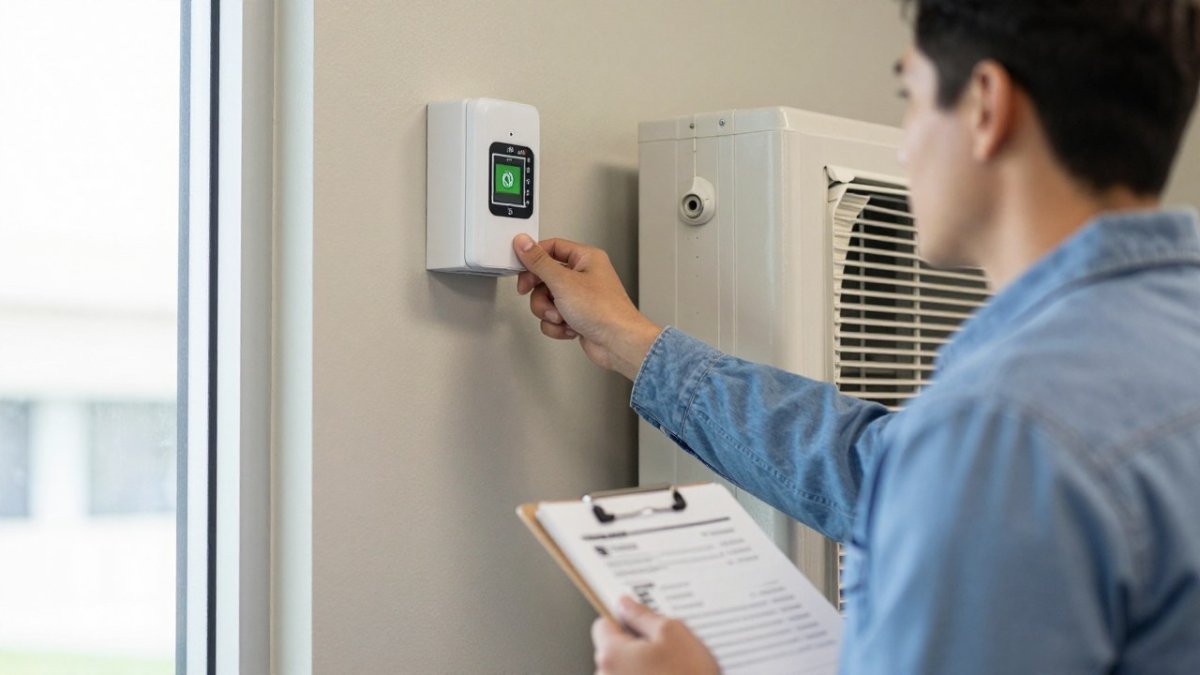
The good news: nearly all of these are preventable. For a step-by-step process, see our guide on how to prevent false alarms.
Sensor-Specific Causes and Prevention
Each sensor type fails in its own way, and the fix depends on the commercial environment. A warehouse, an office suite, a retail floor, and a multi-tenant building put different stress on the same device. Match the mitigation to the sensor and the space:
- Passive infrared (PIR) motion sensors: These trip when a heat source crosses the detection pattern, HVAC vents, space heaters, sun through a loading-dock door, or a forklift engine cooling down. In warehouses, mount PIRs away from dock doors and racking that shifts with temperature; in offices, keep them off walls shared with server rooms. Dual-technology sensors that require both motion and heat to confirm reduce nuisance trips in high-traffic areas.
- Door and window contacts: Misalignment is the leading cause. Loading dock doors, roll-up gates, and exterior doors that flex with weather or settle with foundation movement generate repeated "door open" alerts. Check alignment after every season change and after any dock repair. In retail, contacts on automatic sliding doors need a bypass during business hours so customer traffic doesn't read as an intrusion.
- Glass-break detectors: These listen for the specific frequency of shattering glass, but machinery vibration, loud HVAC equipment, and even nearby construction can mimic it. Mount them away from compressors and test after any equipment change. In multi-tenant buildings, coordinate with neighboring tenants before installing near shared walls.
- Panic and hold-up buttons: Accidental presses are the most common human-error trigger. Store them out of reach of everyday traffic, use covers, and train staff on proper use during onboarding, not just at install.
- Environmental and system-level triggers: Dust, insects, and humidity drift can cause sensors to misread. A zone may alarm repeatedly during cleaning shifts if motion sensors are not bypassed for the cleaning crew's schedule. Build cleaning and after-hours staff into the arming schedule rather than asking them to remember codes.
For a deeper look at reducing specific sensor triggers, our guide to reducing false alarm triggers covers configuration details by device type.
Matching Prevention to the Building Type
The same sensor behaves differently depending on the space. In warehouses, the dominant risks are dock-door contacts, forklift traffic near motion sensors, and dust on lenses, prioritize contact alignment checks and dual-tech motion. In offices, after-hours cleaning crews and HVAC cycling are the usual culprits, use schedules and bypass groups. In retail, customer traffic, automatic doors, and display rearrangements cause most nuisance alarms, set entry/exit delays around store hours and re-test sensors after any remodel. In multi-tenant buildings, shared walls, independent tenant schedules, and inconsistent arming habits multiply the variables, assign unique user codes per tenant and review alarm events by suite monthly.
False Alarm Prevention for Businesses: Configuration and Training
Prevention is a management discipline, not a one-time install task. A commercial alarm system needs an owner: someone responsible for arming procedures, code management, and periodic reviews. Set entry and exit delays long enough for real workflows, especially at shift changes and deliveries.
Training matters as much as hardware. Walk every employee through the arming process during onboarding, and post clear instructions at each keypad. Review alarm events monthly. A pattern of nuisance alarms in one zone usually points to a sensor that needs repositioning or replacement.
Our business alarm system maintenance tips cover the ongoing checks that keep configuration and sensors working reliably over time.
Video-Verified Commercial Alarms and AI Analytics
Video verification has become an important development in commercial alarm reliability. A video-verified alarm pairs intrusion detection with camera footage that a monitoring center reviews before dispatching police. Instead of a blind dispatch, operators see whether a person is actually on site. That step can filter out many nuisance alarms.
How the Verification Workflow Actually Works
The value comes from sequencing, not from the camera alone. A typical verified-alarm workflow runs in stages:
- Sensor trip. A door contact, motion sensor, or glass-break detector triggers an alarm event.
- Camera cue. The panel or monitoring platform automatically pulls a short clip from the nearest camera, typically the seconds before and after the trip, so the operator sees what caused it.
- Operator review. A trained operator checks whether a person, vehicle, or forced entry is visible, or whether the trigger was environmental (a door blown open, a shadow, a cleaning cart).
- Dispatch decision. If a person is confirmed, the operator dispatches police with a description and clip. If not, the event is logged as a verified non-event and no dispatch occurs.
- Customer notification. Intelligent alerts reach your phone with the clip attached, so you can confirm or dismiss in seconds.
This sequence is what distinguishes a verified alarm from a simple camera notification. The operator review step is the filter; without it, you've just added video to the same blind-dispatch problem.
Where AI Analytics Help, and Where They Don't
AI-powered detection distinguishes people from shadows, weather, and moving equipment, and flags genuine suspicious activity like loitering at a rear door or movement in a restricted area. In commercial settings, analytics are most useful for object classification (person versus vehicle versus animal), line-crossing and loitering rules at perimeter doors, and reducing false triggers from moving foliage or headlights. They are less reliable in poor lighting, heavy weather, or crowded scenes, and they can't replace operator judgment for ambiguous events. Analytics can serve as a first filter and human review as a second step, with operators making the dispatch call.
Measuring Whether Verification Is Working
Buyers can compare systems by tracking a few performance indicators:
- False alarms per site-month, the raw nuisance rate; lower is better, but only meaningful alongside verified-alarm rate.
- Verified-alarm rate, the share of alarms confirmed as genuine after review. A rising rate suggests the system and configuration are maturing.
- Dispatch cancellation rate, how often a dispatch is called off after verification. High cancellation is a sign verification is doing its job.
- Time to verification, how long from sensor trip to operator decision. Shorter times mean faster, more accurate response.
Ask your monitoring provider whether they report these metrics and how they define them. A provider that can't supply them is asking you to take reliability on faith.
The trade-offs are real. AI cameras cost more up front, and you need to think through privacy, data retention, and cybersecurity. If you're weighing the benefits before adopting, our overview of the benefits of AI security cameras lays out what to expect.
Commercial Alarm Monitoring: Response Accuracy and Dispatch Outcomes
Monitoring turns a local alarm into an actual emergency response, and the quality of that monitoring determines whether dispatch happens for the right reasons. A commercial alarm monitoring center should verify alarm events before calling police, maintain current call lists, and understand your building's layout.
Ask your provider how they handle a single-zone trip versus a multi-zone event, and whether they support video verification. Some police departments require verification before dispatch for certain alarm types, so a monitoring partner without verification capability may leave some alarms unanswered.
For a full breakdown of plan structures and how they affect outcomes, see our guide to business alarm monitoring plans.
Business Alarm Systems Pricing: What Drives Cost
Business alarm systems pricing depends on scope, not a flat rate. Key cost drivers include:
| Cost Driver | What Affects It | Why It Matters |
|---|---|---|
| Building size and zones | Number of sensors and panels | More zones, more hardware |
| Sensor type | Motion, glass-break, contacts | Specialized sensors cost more |
| Video verification | Camera count and AI features | Adds upfront and monthly cost |
| Monitoring plan | Response level and verification | Higher service, higher fee |
| Installation complexity | Wiring, layout, access control | Older buildings cost more to wire |
Pricing depends on the scope of the system, including building size, sensor types, and monitoring plan. Request a quote from Cyrus Alarm Services based on your actual layout for current pricing.
Get a Custom False-Alarm Assessment from Cyrus Alarm Services
Reducing false alarms starts with understanding why they happen in your building. At Cyrus Alarm Services, we offer custom consultation, installation, and servicing, and test our products in-home before they are offered. As a family-owned business and authorized 2GIG EDGE Panel provider, we pair rigorous in-home testing with Alarm.com integration for remote management and alerts.
Choosing a system on monthly price alone may not address the causes of nuisance alarms. Configuration and verification are central to reducing them.
Get started with Cyrus Alarm Services and build a commercial alarm system that stays quiet when it should and responds when it matters.
Frequently Asked Questions
Which features help commercial alarm systems avoid false alarms?
Look for multi-sensor confirmation (requiring two sensors to trip before an alarm), pet-immune motion detectors, video verification that lets a monitoring center see what triggered the alert, and AI analytics that distinguish people from moving objects or animals. Programmable cross-zoning and sensor sensitivity adjustments also cut nuisance alarms. Cyrus Alarm Services tests its products in-home before they are offered.
How can businesses reduce false alarms from security systems?
Start with a professional site assessment to identify environmental triggers like HVAC airflow, sunlight, or loose doors. Then configure cross-zoning, adjust motion detector sensitivity, and train staff on proper arming and disarming procedures. Schedule annual inspections and maintain a log of every alarm event. Video-verified commercial alarms add a layer of confirmation before dispatch, which can reduce unnecessary police response.
What should a business do after a false alarm?
Document the time, location, and sensor involved, then review whether an environmental factor or user error caused it. Check video footage if available to confirm what triggered the sensor. Report the event to your monitoring provider so they can adjust sensitivity or zoning. If false alarms repeat from the same device, have a technician inspect the sensor and its placement. Consistent logging helps your provider tune the system and avoid future dispatch penalties.
Are wired or wireless commercial alarm systems more reliable?
Wired systems offer stable connections and are less vulnerable to signal interference, which suits large buildings with existing infrastructure. Wireless systems install faster and adapt well to older buildings with difficult wiring, but signal range and battery maintenance matter. Reliability depends more on proper installation, sensor placement, and monitoring configuration than on wired versus wireless alone. A custom consultation can match the right setup to your building's layout and usage.